How to Find Reliable Home Contractors: 7 Steps
Table of Contents
Step 1: Define Your Project Scope Before You Search
Work Out Whether You Need Planning Permission
Sort Out Party Wall and Access Issues Early
Step 2: Where to Find Reliable Home Contractors
Trade Association Directories and TrustMark
Personal Recommendations and Local Networks
Step 3: Run a Digital Vetting Process
Verify Company Registration and Directors
Check for Insolvency and Financial Red Flags
Step 4: Questions to Ask a Builder Before Hiring
Step 5: How to Spot a Cowboy Builder
Step 6: What to Include in a Building Contract
Payment Schedules and Deposit Protection
Step 7: Managing the Build and Resolving Disputes
Run the Build Like a Project, Not a Favour
The Escalation Ladder If Something Goes Wrong
What 'Rogue' Actually Looks Like Mid-Project
Building Control and Completion
Frequently Asked Questions
Last Updated: September 30, 2026
Step 1: Define Your Project Scope Before You Search
Finding reliable home contractors starts with knowing exactly what you need built, and, just as importantly, what you are legally allowed to build. A clear project scope is the single biggest factor in getting accurate quotes and avoiding disputes later.
So before you contact anyone, write down:
What you want built (extension, loft conversion, garage conversion, new build)
Rough sizes and room layouts
Your budget range and contingency
Your ideal start and finish dates
Any planning or building regulations questions
Work Out Whether You Need Planning Permission
This is the step almost every guide skips, and it is the one that stops projects dead. Two separate regimes apply, and they are often confused:
Planning permission controls whether you may build the thing at all, its size, position, height and impact on neighbours. Many domestic extensions and loft conversions fall under permitted development rights, which means no application is needed, but those rights are subject to limits on depth, height, eaves and the amount of the original house covered. Flats and maisonettes have no permitted development rights for extensions at all.
Building regulations control how the thing is built, structure, fire safety, damp proofing, ventilation, energy performance and drainage. These apply to virtually all building work, whether or not planning permission is needed.
Sort Out Party Wall and Access Issues Early
If you share a wall, floor or boundary with a neighbour and your work involves excavation near their foundations, cutting into a party wall, or altering a party structure, the Party Wall etc. Act 1996 applies. You must serve notice, and the neighbour can dissent, which triggers the appointment of surveyors. This is a legal process with its own timetable, and it runs in parallel with planning, not after it.
Pro Tip A common mistake is treating your first quote as your real budget. Contractors price what you describe. If your description is loose, your quote will be too, and the gaps get filled with expensive variations later. A brief that names the planning route, the building control route and the access constraints is worth more than a page of mood boards.
Step 2: Where to Find Reliable Home Contractors
The best place to find reliable home contractors is a mix of trusted directories and people who have already used them. No single source is enough on its own.
Trade Association Directories and TrustMark
Trade association directories list firms that have met a membership standard. TrustMark is the government-endorsed quality scheme for work in and around the home, and you can search it through TrustMark's official find-a-tradesperson service.
Personal Recommendations and Local Networks
Ask neighbours, friends and local Facebook groups who they used and whether they would use them again. The follow-up question is the important one.
Step 3: Run a Digital Vetting Process
Digital vetting means checking a firm's official records online before you invite them to quote. It takes about fifteen minutes and filters out most problem builders.
Gosforth Handyman
Verify Company Registration and Directors
Search the company on Companies House, the official register for businesses. Check three things:
The company is active, not dissolved
The registered address matches what they told you
The directors are who they claim to be
Check for Insolvency and Financial Red Flags
Look for a history of dissolved companies linked to the same director. Frequent name changes or repeated liquidations suggest a pattern worth avoiding.
Watch Out Never accept a photocopied insurance certificate without checking the policy dates and the level of cover. If a builder cannot produce a current certificate, walk away. You could be liable for damage or injury on your own site.
Step 4: Questions to Ask a Builder Before Hiring
The right questions to ask a builder before hiring separate the professionals from the chancers. Ask them in person and listen to how they answer, not just what they say.
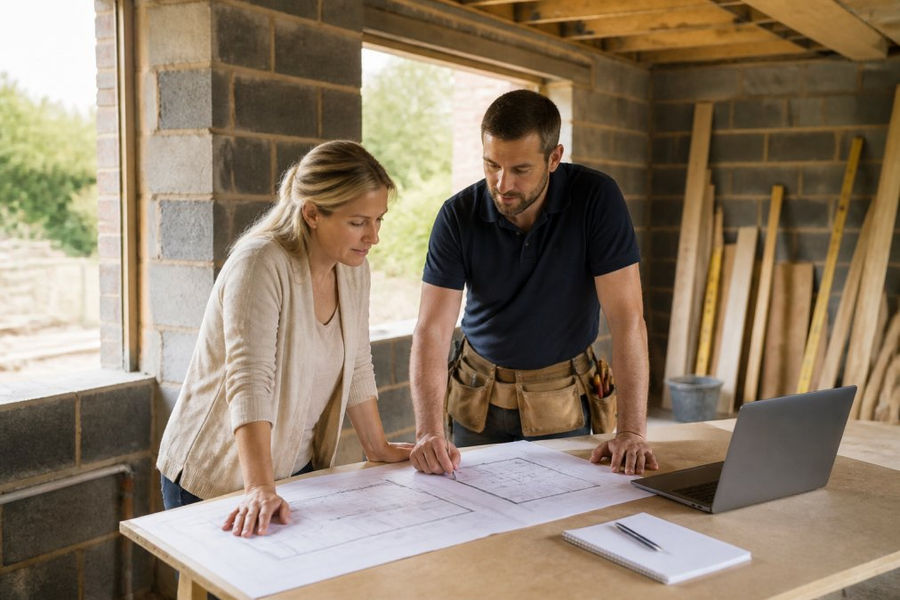
Ask these, and note the answers:
Can I see your public liability and professional indemnity cover?
Are you a member of a trade association, and which one?
Who will actually be on site each day, you or subcontractors?
Can you give me three recent references I can call?
How do you handle variations and changes to the plan?
What is your payment schedule, and do you want a deposit?
Who manages building control sign-off and completion certificates?
Step 5: How to Spot a Cowboy Builder
You spot a cowboy builder by their pressure tactics, their paperwork and their payment demands. The warning signs are consistent and easy to learn.
Watch for:
A demand for a large upfront cash deposit
No written contract, or a contract that arrives after work starts
Quotes given without ever visiting the site
Prices that are far below every other quote
No fixed address, landline or verifiable registration
Reluctance to provide references or insurance details
Pressure to decide on the spot
Step 6: What to Include in a Building Contract
A building contract should set out the project scope, the price, the payment schedule, the timeline and how disputes get resolved. If it is missing any of these, do not sign it.
A full written estimate and fixed-price quote where possible
A clear project scope with drawings and specifications attached
A payment schedule tied to milestones, not dates
Start and completion dates with any penalty terms
How variations are priced and approved
A workmanship guarantee and defect period
The dispute resolution process
Payment Schedules and Deposit Protection
Never pay a large deposit upfront. A milestone-based payment schedule protects you and keeps the builder motivated.
Stage | Typical Payment Trigger | What to Check First |
Deposit | On signing | Written contract in place |
Stage 1 | Foundations complete | Building control inspection passed |
Stage 2 | Structure and roof on | Workmanship matches drawings |
Stage 3 | First fix and plaster | Snagging list started |
Final | Completion and handover | Completion certificate issued |
Step 7: Managing the Build and Resolving Disputes
Managing the build well comes down to communication and records. Keep everything in writing, from day one. This section goes further than most guides: it sets out the actual escalation route if a project goes wrong mid-way, which is the point at which most homeowners discover they have no plan.
Run the Build Like a Project, Not a Favour
Set a weekly check-in with your builder, in person or by call, and follow it with a short written summary of what was agreed. Photograph progress at the same time each week from the same angles. Note any changes and confirm them in writing before work continues, a variation agreed verbally and disputed later is the single most common source of building disputes.
Keep a single folder, physical or digital, containing:
The signed contract and any agreed variations
The payment schedule and every receipt or bank transfer record
Insurance certificates, trade association membership numbers and company registration details
Building control inspection records and completion certificates
Your weekly notes and photographs
The Escalation Ladder If Something Goes Wrong
Work through these steps in order. Do not skip to the end, because most dispute routes require you to have tried the earlier ones first.
Raise it in writing with the builder. State the defect or breach, reference the relevant contract clause, and set a clear deadline for a response. Keep it factual and dated. This letter matters later.
Check the contract's dispute resolution clause. Many trade association contracts require a specific sequence, usually negotiation, then mediation, then arbitration, before court. Following it protects your position.
Use the trade association's complaints or dispute service. If the builder is a member of a recognised scheme, the association will typically offer a conciliation or dispute resolution service as a condition of membership. This is often free or low-cost and is far quicker than court.
Try mediation. Mediation is a structured, voluntary negotiation with a neutral third party. It is not binding unless you agree a settlement, but it resolves a large share of building disputes at a fraction of the cost of litigation, and courts expect you to have attempted it.
Consider legal action as a last resort. For smaller sums, the small claims track of the county court is designed for exactly this kind of dispute and does not require a solicitor. For larger sums, take advice before issuing proceedings, because costs escalate quickly and the losing side may pay.
What 'Rogue' Actually Looks Like Mid-Project
The warning signs do not stop once work starts. Watch for:
Requests to move to the next payment stage before the current one is finished
Sudden absence from site with no explanation or a rotating cast of unfamiliar subcontractors
Refusal to put anything in writing after previously being happy to
Requests for cash and a reluctance to provide a VAT invoice
Pressure to sign off a stage you are not satisfied with
Building Control and Completion
Do not release the final retention until building control has issued the completion certificate and you have a signed handover with any snagging items listed. A completion certificate is not a nice-to-have, it is the document a future buyer's solicitor will ask for, and its absence can hold up a sale years later.
Key Takeaway The firms that cause the most trouble are rarely the cheapest. They are the ones with no paper trail. Contracts, certificates and written records are your best protection, and a written escalation plan is what turns a dispute from a crisis into a process.
Frequently Asked Questions
How can I verify if a builder is legitimate?
Start by checking the company's registration on the Companies House website. Look for their VAT registration if they are turning over more than the threshold. Ask for their public liability insurance certificate and verify it with the provider. Check if they are a member of a trade association like TrustMark or the Federation of Master Builders. A legitimate builder will happily provide these details and won't pressure you to skip this vetting process.
What should I look for in a written estimate from a builder?
A written estimate should break down costs for labour, materials, and any subcontractors. It should clearly state what is included and excluded from the project scope. Look for a fixed-price quote or a detailed breakdown if the work is complex. Check for a payment schedule with milestone payments, not a large upfront deposit. Ensure it mentions who is responsible for building regulations and planning permission. A clear estimate protects you from unexpected costs.
How do I check if a builder is registered with TrustMark?
Visit the TrustMark website and use their 'Find a tradesperson' search tool. You can search by trade type and location. TrustMark is a government-endorsed quality scheme, so registered firms have been vetted for technical competence and customer service. If a builder claims to be registered but doesn't appear on the search, ask for their registration number and verify it directly with TrustMark. Never take a logo on a van as proof.
Finding reliable home contractors is not about luck. It is about a clear scope, proper vetting and a contract that protects you. At Sd Architecture, we take that burden off your hands with hands-on site supervision, planning and building regulations expertise, and full project management from first sketch to finished build. Get started with Sd Architecture and move your project forward with confidence.
Get Started Today


Comments